
The Pilgrims’ Way
Pilgrimages from London and Winchester to Canterbury began within a few years of the murder of Archbishop Thomas Becket in 1170 during the reign of Henry II, and grew rapidly over the next centuries. However, with the Dissolution of the Monasteries by Henry VIII, all commemoration of Becket was banned – well, he was an Archbishop who had defied the king, and Henry VIII wasn’t going to stand for that. St Thomas Becket was only officially restored to the Church of England calendar in 1980.
Pilgrimages became much less common from then on and much of the route was slowly lost, sections apparently only being known locally. There was renewed interest in the 19th century and research started to try to recreate the route. Sections displayed on early OS maps were at times only conjecture and cannot be relied upon.
I followed the Pilgrim route as defined in Walking The Pilgrims’ Way, by Leigh Hatts, published by Cicerone.
As far as Farnham, the route largely follows the modern St Swithun’s Way, whereas later it follows the North Downs Way. However, the NDW tends to keep to the upper parts of the downs, whilst the pilgrim route keeps closer to the lower edges of the escarpment, passing the villages, churches and many palaces along the route. As such the PW and NDW are often diverge.
For the pilgrim, this is not always good news, since many parts of their route are now on metalled roads, although thankfully usually quiet roads.
The guide book suggests taking 2 weeks to walk the 138 miles.
I started on Monday 1 July 2019, finishing in Canterbury a week later, on Sunday 7 July, a day celebrating the Translation of St Thomas Becket, when in 1220 his body was moved from the crypt up to a new shrine.
The following links describe the seven days of walking, during which, with my various deviations to hotels I covered some 145 miles.
- Day 1 – Winchester to Alton
- Day 2 – Alton to Guildford
- Day 3 – Guildford to Reigate Hill
- Day 4 – Reigate Hill to Dunton Green (near Sevenoaks)
- Day 5 – Dunton Green to Aylesford
- Day 6 – Aylesford to Kennington (near Ashford)
- Day 7 – Kennington to Canterbury
What did I learn?
- Beer is best consumed after the day’s walk is complete.
- Keep to the shade, especially when the sun is out and the temperature is in the mid-20s.
- Early starts are good. It’s peaceful, it reduces the amount of walking in the afternoons when the temperatures are at their highest, it allows time to dawdle should one wish, and one arrives at the destination in good time.
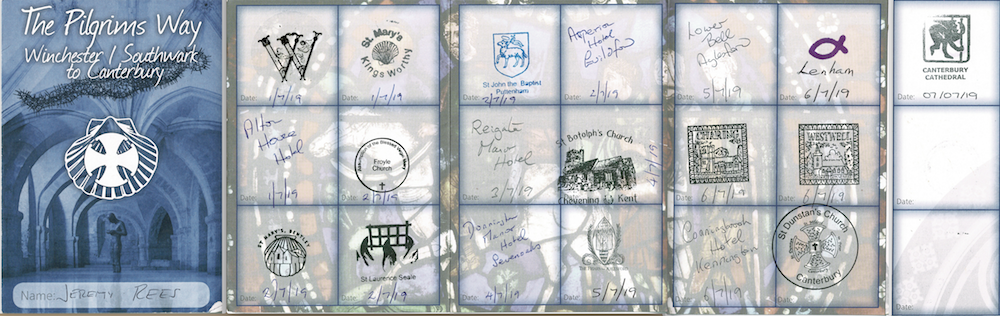
- Pilgrim stamps are available at perhaps half the churches, unless you get there too early.
- There doesn’t seem to be much fauna – I saw a fox one day and that was about it.
- In the whole week I saw, and just briefly, only one other person backpacking, and that was on the NDW. Otherwise, there’d only be early morning joggers, weekend cyclists / walkers, and teenagers doing Duke of Edinburgh Awards.
- The churches sometimes have a visitors’ book, and there are entries by those following the PW – but I didn’t add to them.
- There are a lot of churches and palaces along the route, underlining its wealth and power.
- The nobles and rich making the pilgrimage would have been well looked after – and their horses no doubt.
- There is a lot of history on the way.
- There is a limited choice of accommodation, but I was able to book each hotel I stayed at a couple of days in advance – although the choice was always very limited.
- I was typically paying over £100 a day for the hotel room and my food.
And in conclusion
I enjoyed the walk.
I started it an atheist, and whilst that hasn’t altered, I think I appreciate the religious side a bit more, so l long as it is treated as a guide to living, rather than absolute truth. IN my view, as soon as any religion – or indeed any company, political group or association – takes itself too seriously and starts to deny other perspectives then things become dangerous.