Day 5 – Dunton Green to Aylesford

Another 4:30am start, but easy as the PW was right next to the hotel.
First town, Otford, which was associated with Becket, and he stayed here in 1162 during his first year as Archbishop. Otford Palace, like many others is now ruined, but has a Becket’s Well in its ground. Henry VIII and Catherine of Aragon stopped here on their way to the Field of Cloth of Gold Summit in 1520.
On leaving Otford, a large SUV drove up beside me, the driver wound down the window and asked “Are you a pilgrim”. I had to think about that, but then replied “Well, sort of” – so clearly it wasn’t a definitive “Yes” or “No”. But I think it an appropriate answer. He wished me luck and drove on.
Soon passed through Wrotham, with the ruins of another Old Palace, which like many on the PW, was used by bishops, travelling to and from Canterbury. Thomas Becket was one of them, staying there just 2 weeks before his murder. Clearly a lot of the aristocracy who undertook pilgrimages had a very comfortable life.
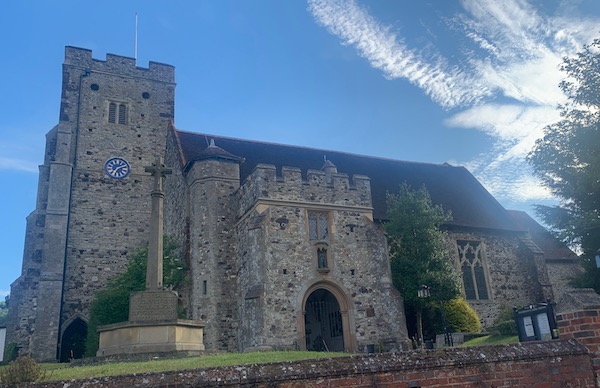
The church in Wrotham is one of the earliest dedicated to St George and is unusual in having an archway at the base of the tower – supposedly to allow outdoor processions to go round the church. According to their website they get pilgrims stopping for a passport stamp, but clearly they aren’t catering for those that turn up before 6am. One of their rectors – Richard Bancroft – become Archbishop of Canterbury in 1604.
St George was a soldier of Greek origins, member of the Praetorian Guard for Roman emperor Diocletian, who was sentenced to death in AD 303 for refusing to recant his Christian faith. He became one of the most venerated saints, especially venerated as a military saint since the Crusades. He is the patron saint of England and quite a few other places – Ethiopia, Catalonia, ….

At Halling, I stopped for a coffee in the pub. It wasn’t actually open, but I got one anyway. I also bought some chocolate type bars at the village store – but they were disgustingly sweet so were thrown away. The Bishop of Rochester’s Palace was here, again now in ruins.
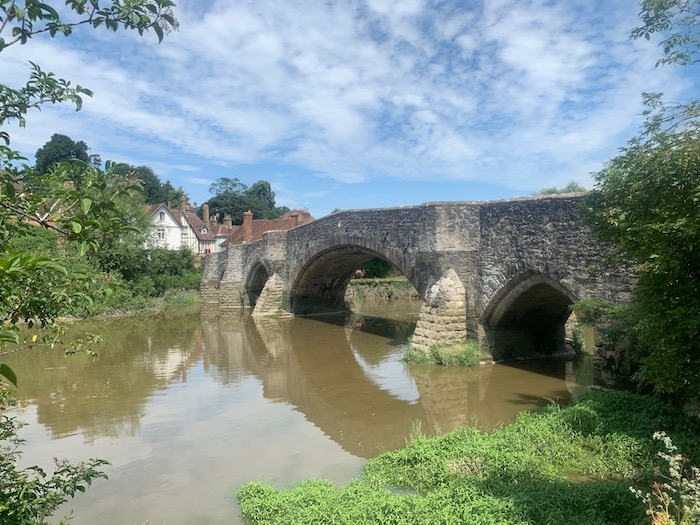
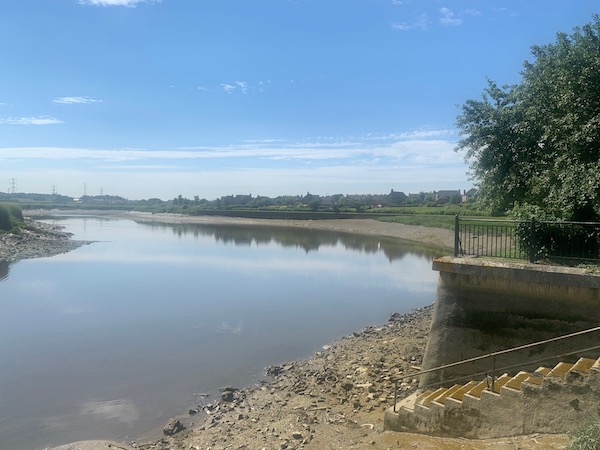
Pilgrims are thought to have crossed the Medway here, the ferry only closing in 1963. Other options were a ferry at Snodland a mile or so further down, or the bridge at Aylesford, yet further down.
On the outskirts of Aylesford is the Carmelite Priory, known as The Friars which was founded in 1242.
The community was expelled in 1538 by Henry VIII and it was not until 1948 that they returned.


I stopped here for a sandwich in the tearoom, where there weren’t many, but there was a group of 4 young Italians.
I obtained a passport stamp at reception, and whilst waiting, a lady was handing in a form to have a prayer read for a month for a relative.

Later I had coffee and cake in The Pilgrim’s Hall. The latter was built in 1280 and is now the dining room. The group of Italians and a few other young people were having lunch at a reserved table and I got the impression they were staying there on some course or other.
The chapels were all decorated between 1966 and 1986 by Adam Kossowski, and are very modern in style. I lit a candle on behalf of Catherine, in remembrance of Yvonne, her mother.
A pottery at the Friars was founded by David Leach, son of Bernard.
From Aylesford, it wasn’t far to my stay at The Lower Bell pub. I arrived around 3pm, so 21 miles covered in just over 10 hours – but I had stopped at The Friars for quite some time.
One thing that strikes me now was that I noted having seen a couple of foxes this day. Which probably means I’d seen very little wildlife on the rest of the walk.